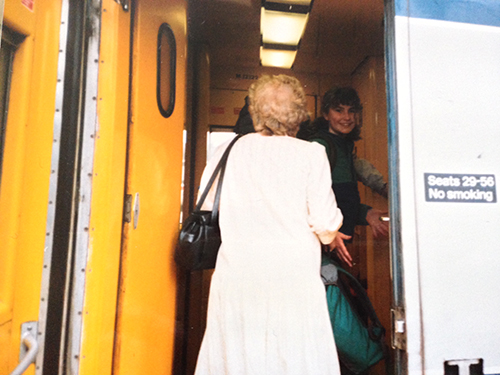
Absence of an Only Child
Because my daughter is an only child, I used to send her on many trips and expeditions throughout her school years. All the partings and reunions followed a similar pattern. I would see her off with tears in my eyes before returning to the house. I would mope around, missing her and feeling so downcast and dejected. Later, I would learn that she had been in Seventh Heaven, enjoying new pursuits in the company of other children her own age.
Her longest absence was for six weeks and that was in the Lower Sixth when she went on a scientific and medical expedition to the Western Himalayas. That experience turned out to be the pivotal point of her life. She returned in a state of animation and excitement. She was glowing with joy and I'd never seen her so animated and talkative.
On leaving school the following year, she spent a gap year in Indonesia. This was the hardest parting of all for me. On the morning of her departure I accompanied her on the coach to Heathrow. I kept saying to myself, 'Don't take your eyes off her. Let the picture of her sitting in the coach burn itself into your memory so that this moment is cemented in eternity. Listen to her and remember the sound of her voice. This will keep you close to her.'
When we arrived at Heathrow, the Volunteers were already checking in, the wealthier parents writing hefty cheques for excess baggage. Anna and I had to juggle items between her rucksack and hand baggage. What could she wear to reduce the weight in her rucksack? What could she do without and give me to take home? In our concentration we kept at bay the realisation that the moment of parting was fast approaching. Finally, they were ready to go through to departure. I couldn't bear to watch her disappearing from my view. I decided to catch the coach which was due shortly. I hugged her tightly, trying my hardest to put on a brave face while we were together. Then I hurried away. Unknown to me, however, she was trailing me, silently and at a distance, down the escalator to the Arrivals area leading to the coach. Then, like Lot's wife, I looked back. That tore it! I turned into stone, petrified in my tracks. I caught such a naked, unguarded expression of apprehension and momentary desolation on her face. My whole being ached to run back and cling to her and beg her not to leave. I resisted the urge. Instead, I ran sobbing to the coach and cried and sobbed all the way home. I was beside myself with grief.
I wrote in my diary: Back on the same coach. There's the seat Annie sat in just two hours ago - top RHS. Annie, it's hard being a mother losing your child to the world. One day you'll understand. God protect you till we meet again. Thanks for all the lovely years and your companionship and the incentive you gave me to fight to stay alive for you. Remain beautiful inside.
On another page I continued: What a traumatic journey home alone on the coach and empty inside as if the world has crashed around me! Never again will I feel so bereft. Annie, look back on this year and try to imagine the people you left behind. Now I know what it is to lose a child. How do people survive? How do they cope? 11.8.89.
I was feeling pretty desperate when I wrote those words. It was as if by recording them I could ease the unbearable pain.
On arrival in Wolverhampton, I rang my husband to say I'd wait for him in Sainsburys restaurant. I went into the shop and began to fill a basket with groceries. So many packs contained three pieces, like three chicken breasts, that it suddenly dawned on me that from then on I'd be catering for only two people. At that I broke down completely, dropping the basket and fleeing, sobbing, to the cloakroom. Finally, I composed myself enough to sit in the restaurant. I was inconsolable.
Back home, I went into Annie's room and sobbed afresh into her pillows. Everything was as she'd left it. I kept calling her name but in vain. There was no response, nothing save an unearthly silence, a lack of warmth, a coldness and darkness. The life had gone from the room the room which so recently had been alive with her presence. Her pictures, dolls, ornaments, books, all seemed frozen into a state of suspended animation. In all our months of preparation I couldn't have foreseen my reaction.
I thought of the five mothers I'd known whose children had died tragically, all of them contemporaries of Annie. However sad I'd felt for them, I couldn't really have understood their sorrow and anguish but suddenly I thought: 'Now I know!' It was as if an essential part of me had been ripped away, leaving a deep, dark void.
I had to learn the painful lesson that we can't hold on to our children. We have to let them go, let them take over responsibility for their own lives. We had been so close. She had been the centre of my life for eighteen and a half years. Now she was gone - far away, to a different continent, a different culture. We were well and truly separated. She had a whole new world opening up for her and in her zest for life she would investigate and explore to its limits every element of adventure. I had to work out a new role for myself. It wasn't easy. She is my only child. I wished I were a little bird so that I could fly across the seas and perch on her window-sill and watch over her, unobtrusively. I wanted to go on sharing her life. The best I could do was cross off the days in my diary, all 365 of them, one by one, tediously, till her return. Day followed night. Night followed day, for eternity, it seemed at first.
I tried not to think of the nights I had sat by her bed, telling her stories and then laying my head on her pillow till she fell asleep. I tried not to think of waking up in the mornings when she was a baby and hearing her call out: 'Am-mee and seeing her face light up when I tip-toed around her door. Above all, I tried not to think of the distance between us and I tried not to recall the image of her temporarily sad, bewildered face as she watched me walk away from her at Heathrow. Christmas was a difficult time but once the New Year arrived, the days brightened. The crossed-off days increased. The uncrossed ones decreased.
At last I was back at Heathrow, eagerly scanning the Arrivals board, watching 'Jakarta' jump up the list till it reached the top, and 'Landed' appeared in the Expected column. That year changed Anna. The young woman who came through, wheeling two piled up luggage trolleys and searching the crowds for her Mum, was very different from the daughter returning from India two years earlier. Her whole being spoke of a loss of freshness and innocence. An inner light had been extinguished. Was this how shell-shocked soldiers, emerging from the trenches in World War 1, looked? It took us both some time to come to terms with the transition. We survived.
Every spring a starling comes and nests in the eaves of our house. At the appropriate time the mother bird pushes her babies, one by one, from the nest and teaches them to fly before sending them on their way to fend for themselves. As I watch, I think of Anna. I ask myself: 'Could I ever be like the mother bird and be spared the emotional extremes of elation and despair which sear my soul till, for my protection, I allow my feelings to be anaesthetised?'
I search for answers to the questions which torture me.
Was I right to send my daughter on that gap year? Having always tried to provide a protective environment, insulated from the harsher, darker seams of life, should I have plunged her so early into a world I myself was ignorant of? Would her spirit of adventure and her desire to explore every unknown mystery not have led her into extreme danger wherever she found herself?
I don't have the answers. Perhaps Anna does. Looking at her as she prepares for another long trip abroad, I can't but be proud of what she has done with her life so far. In losing her for a while I have found her afresh. In my learning to let go, she has returned each time.