My Family
This is an article I wrote for the Reader's digest who normally didn't return scripts but they said it was worth pursuing so they were sending it back to me to do further work on. I made it the basis of my family research.
I was born in the hunting-lodge of Bessborough House, Piltown, Co. Kilkenny, in 1928 into a poor but proud protestant family. Piltown was a tiny village in Eire and Bessborough House was Lord Bessborough's Irish Estate. At that time, the world was a very different place.
My father, William George Hartford, was the carpenter working on the rebuilding of the house, which had been burnt by the IRA during the Troubles. He was born on the 3rd October, 1896, to James and Martha Hartford, of Abbeyleix, Queen*s County. James was Clerk of Works on the de Vesci estate. In 1909 my father started a seven-year apprenticeship under his father.
Auntie Fanny was my father's sister and Uncle Charlie's twin. She married Wiilie Farley and Rob was their only child. He married Audrey from London. They originally lived in Dartmouth road Ruislip, a house they bought in 1935 for £1750. Their two children are sean and Sarah. Sean now lives in Wimbledon.
The two photos below are of Martha and her family, a few years apart.
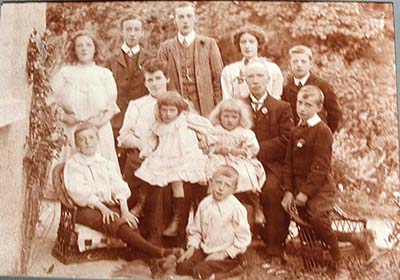
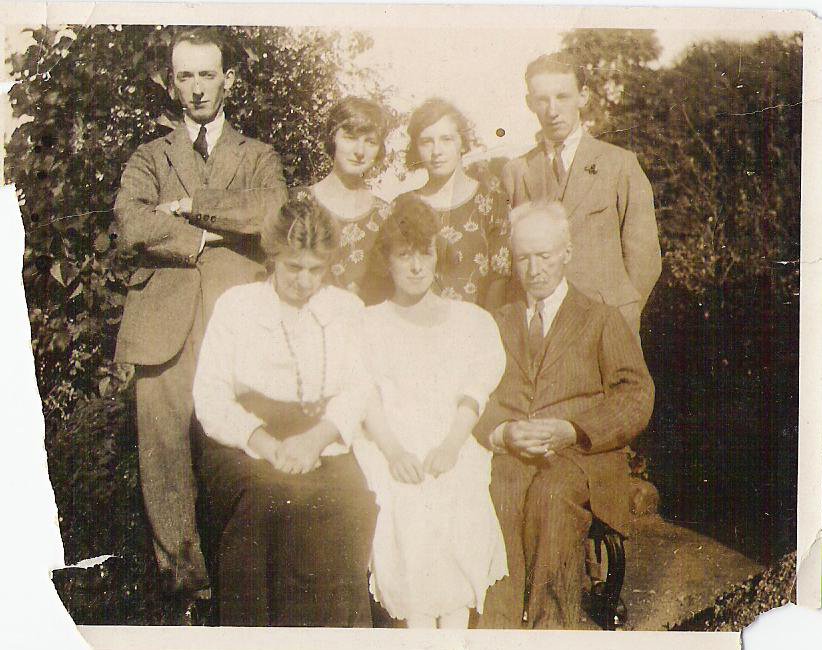
In the first photo, on the back row: Aunt Fanny, my father, Uncle Eddie, Aunt May, Uncle Henry... Front: Uncle Charlie, Grandmother Martha with Aunt Gladys on her knee, Uncle Dick sitting on the ground, Grandfather with Aunt Aileen on his knee, uncle Fred
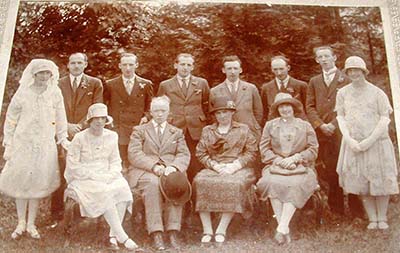
In the last photo, taken at Aunt Aileen's wedding:
Back row: Uncle Eddie, Uncle Henry, Uncle Charles (twin of Aunty Fanny (Muriel used to call her Aunt Peg ), my father, Uncle Fred, Uncle Richard, Aunt Gladys. Front row: Aunt Aileen, Aunty Fanny (Twin of uncle Charles), my grandfather, my grandmother, Aunt May.

In the above picture, my husband and I are visiting Aunty Fanny in her house in Dartmouth Ave, Ruislip, when Anna was a toddler. It was Rob's London house that she and Uncle Willie moved into when they sold Fordville.
This photo shows the Farleys, Uncle Fred and maybe Ted.

My mother was also born in Abbeyleix, on the 25th March, 1892, to John and Mary Shekleton, at her maternal grandmothers home in Knapton, her grandfather Foster being gamekeeper on the estate.
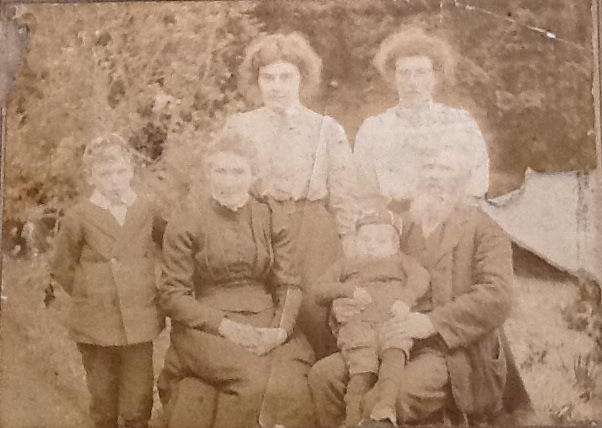
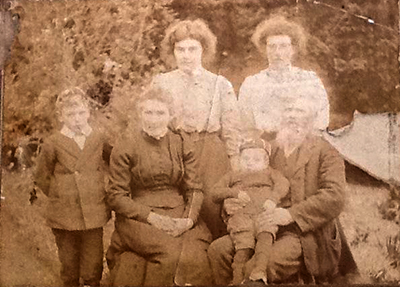
In the last picture taken in Fordville Garden in the back row are Uncle Henry, my father's brother (died of TB in 36), my great grandma, Aunty Aileen (my cousin Aileen's mom), May Hartford (my aunt) and Uncle Dick (who was a clergyman and the 2nd youngest of 10 children). Front row, my grandmotther, auntie gladdys (my father's youngest sister, who died in 1929) and my grandfather, Uncle Dick, who was a clergyman and the 2nd youngest of 10, pictured in Fordville family Garden.
Mary Skekleton (my grandmother) and Martha Hartford (my grandaunt) were sisters, so my parents were first cousins.
My mother's sister, our Aunt May Shekleton, was Assistant Matron in the mental hospital in Kilkenny and she used to come to visit us on her day off on a Thursday. She always cameladen with bags containing presents for all of us and food for our mother. We used to walk through the de Vesci demesne to the station to meet her off the train and help her carry the bags. We could scarcely wait to find out what she had for us. I remember the three pixie caps she brought for Helen, Muriel and me. Mine was blue, Helen's green and Muriel's red. We wore them even when we went to fetch water from the tap across the road. She is pictured here with the lupins she loved in Rathdrum.
Aunt May is the Aunt who had TB and probably gave it to Margaret, Muriel and I when we stayed with her and Uncle Joe in Rathdrum. All of my mother's family except my mother are buried in the one plot in Ferns cathedral graveyard. You traced the names with your finger for your D of E family tree research. Mary Skekleton (my grandmother) and Martha Hartford (my grandaunt) were sisters, so my parents were first cousins.
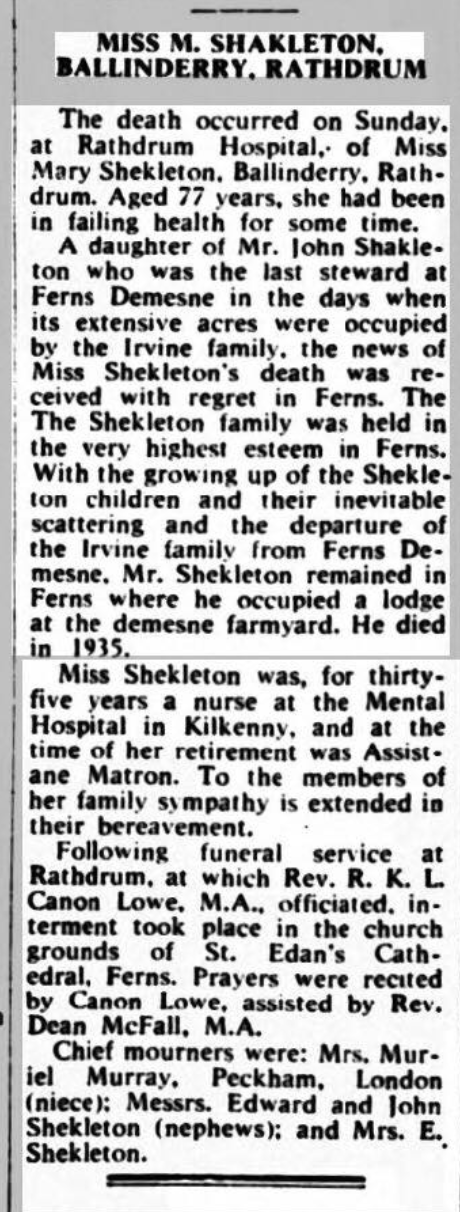
Two of her brothers, my uncles, (Wilfred and another) died in their teens.
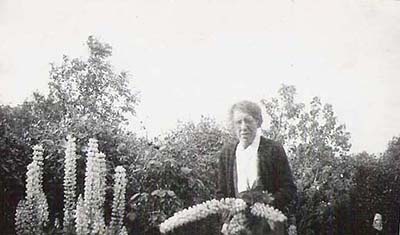
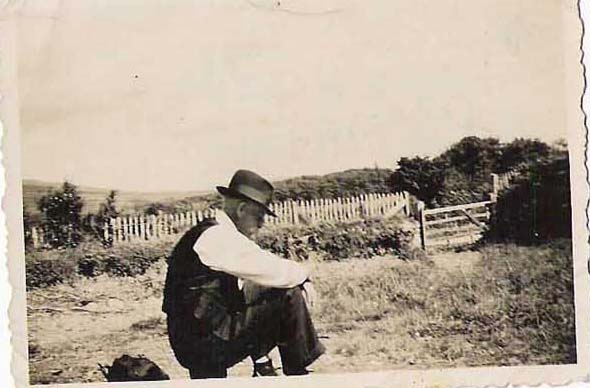
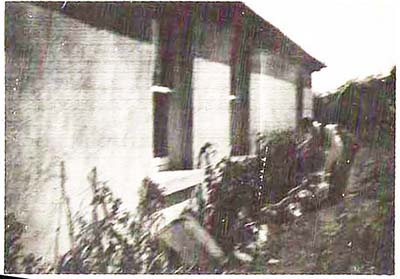
The first photos is of my aunty May and Lupin's at mom's aunt shekleton and the second is of my mother and her sister Mae's Uncle Shekleton. The third is of Aunt Mae's uncle, Joe, gardening outside their bungalow in Rathdrum.
My mother grew up in Ferns, Co. Wexford, where her father was land-steward to the Irvines. On leaving school, she went into service with the FitzHerberts in Abbeyleix. There she remained till she married my father, her first cousin, on 24th October 1917. Captain FitzHerbert was the land-agent for Lord De Vesci.
My mother was a servant in the home of Miss FitzHerbert's (Eileen's) parents, Millbrook, prior to her marriage to my father. She remained friends with my mother throughout her life and they had lunch together near the old church after her parents passed away. This is a photo of Miss Fitzherbert and my mother and father in later years.
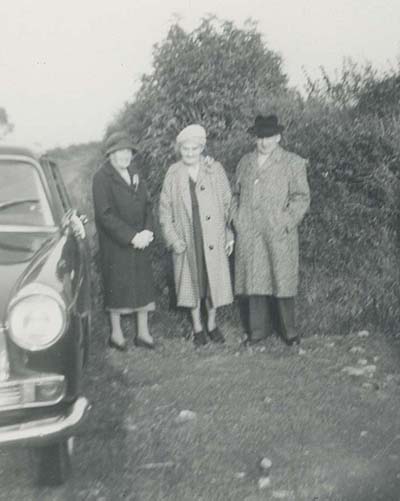 missfitzherbetgdmagdpa
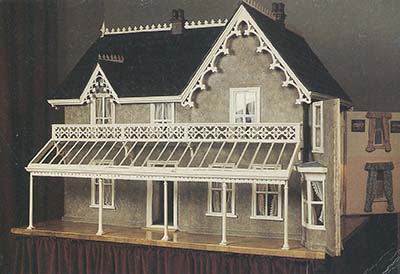
When she was grown, Eileen lived in the farm cottage estate house which had been my father's old office - the same house which was the model for the doll's house he made which may still be on display in Longleat.
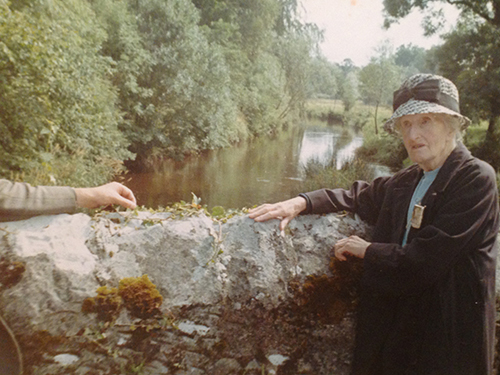
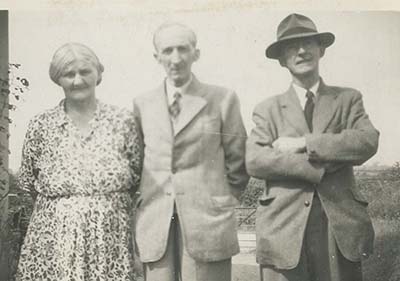
This is a photo of my mother, father and my uncle Fred.
1909 - 1917: My Father's Apprenticeship Years.
Shortly before he died, my father seemed to be reliving these years. He spoke of Lord Bath's sister visiting him every day while she was staying with the de Vesci's. One day she ran in, saying she was being sent home to England, and wanted to explain why she wouldn't be seeing him again. Some years ago I discovered that she was Lady Beatrice Thynne, of Norton Hall, near my Cousin Aileen's in Northhamptonshire. Aileen's husband's uncle, Charles Sanders, was a gardener in Norton Hall and Aileen's son-in-law's mother worked in the sewing-room. She told Aileen about those years. I have discovered more about Lady Beatrice because a writer who was researching Norton Hall called to see Aileen and Vic and was interested in the story about my father. I shall attach a copy of information he gleaned after he had visited the National Library in Dublin. Lady Beatrice was rather eccentric and she was a member of the Bloomsbury group and delighted in the company of men from different backgrounds to hers. She never married.
I now also know that the Lady de Vesci Lady Beatrice was visiting was her grandmother, whose daughter had married the then Lord Bath. This explains, too, the origin of the doll's house on display at Longleat, the ancestral home of the Bath family. My grandfather's office was a pretty house called 'Farm Cottage', built for his predecessor, Matthew Curry, a master carpenter from Cheshire. The doll's house is a replica of Farm Cottage and was made by Mr Curry, under whom my grandfather served his apprenticeship.
1917 - 1919: My Parents' Marriage and My Father's Wartime Service
I first learned about my parents' courtship from Mrs Power, wife of my first headmaster under whom I began my teaching career in Dublin. She remembered accompanying her parents as a 12-year-old girl, in 1917 when they visited my grandparents in Abbeyleix. My father was to be sent to work for her father, Mr Dickie, a Scotsman, who owned the Kilkenny Woodworkers. My parents had fallen in love and wanted to marry. Neither family approved of cousins marrying, so they were to be separated. This, however, didn't deter them, for on the 24th October, 1917, they were married in Kilkenny Registry Office before fleeing to England.
My mother then went to work in Chingford, and my father turned up at a Camp on the Surrey Downs, where his brother, Charlie, was serving with the ground forces of the Royal Flying Corps. Wishing to identify the Camp, I decided that the Public Records Office in Kew was an obvious starting-point but they said they didn't hold records of privates. However, they have pages of entries for my father's eldest brother, Edward, who in 1916 joined the London Rifles and served in France, Salonika, Egypt and England.
My nephew, Richard, recently sent me my father's identity disk, which, until then, I never knew existed. It gives name and number and corps / regiment as RAF and religion as CE. With this information, the Ministry of Defence searched for his records but it took three months before they informed me they had found nothing. Meanwhile, using information obtained from Surrey History Centre and from history books, I concluded that the Camp was Kenley. The RAF was formed in April, 1918, and within two weeks were on a bombing offensive in France and Belgium. Kenley had opened in summer 1917 as 'No. 7 Aircraft Acceptance Park', equipped with 14 aircraft hangars, so the dates are right and it looks as if this is where my father trained before being sent to the Front with the RAF. Michael, my nephew, told me my father worked on Handley Page bombers, which are listed among the aircraft received at Kenley from the Croydon Assembly. I remember my Uncle Charlie saying that he was once asked to chaperone Miss Shackleton and her friends while they rode in a carriage with a rich foreign gentleman. Using my local library, I have discovered that the Shackletons moved to Croydon from Co. Kildare, and as Croydon is very close to Kenley, this is additional backing for believing Kenley to be the site. I have a letter from Lady Shackleton and she doesn't think my uncle would have referred to her aunt, who was 13 at the time as a 'young lady' but I know he would have done so.
I have since then found my father's records in the PRO. I have a copy but I need someone to interpret the information for me...
My sister, Helen, remembers my father describing days on end in the trenches, with lice-ridden bodies from being unable to wash or change clothes. In my reading, I have come across matching descriptions.
Richard recalls my father's tale of a near-mutiny when on Christmas Day the men were given dry biscuits and bully-beef for dinner. They began banging their billy-cans with their spoons. Officers arrived and appeased them by sending lorries into the French countryside for more seasonal fare. This had to be Christmas 1918. I have found a birth certificate for a child, Eileen Mary, born on 18th October, 1918, which again helps to date when my father went to the front. The records show that he was allowed home on compassionate leave when the baby was seriously ill and that he became ill and was admitted to the Queen charlotte Hospital in Dublin. I have yet to identify this hospital but I vaguely recollect my father pointing to The Royal College of Surgeons in Stephens Green and telling me it was a military hospital in WW1. Uncle Charlie told me a tale of the flu epidemic. He was admitted to the camp hospital and all around him bodies were being removed from the wards in bags and he, in delirium, feared he was next so he got up and left the hospital and wandered around the Surrey downs for several days till his fever abated and he returned to the camp. He reckoned that saved his life.
1919 1923: Return to a Troubled Ireland
After his discharge my father must have worked in Co. Wexford till the work on Bessborough began. I remember his once mentioning that their baby was dangerously ill but that the only doctor nearby was Dr Ryan, later Minister of Health in de Valeras government, who had a price on his head. My father cycled to Dr Ryan's house and Miss Ryan, future wife of President Sean T. OKelly, came to the door and said she didnt know where her brother was. However, my father's desperate pleas worked and she told him to go home and the doctor would be there shortly. Dr Ryan visited but the child died from meningitis. My friend in Dublin discovered that Taghmon was where the Ryans came from. More can be found out about them here.
This was the time of the Troubles in Ireland. My sister, Muriel, remembers our parents' descriptions of the horrors of those years. One day my father approached Abbeyleix station where he was to catch a train back to our mother. He found the station closed and deserted. Suddenly, an IRA man was holding a gun to his head, accusing him of being a British spy. An ambush must have been taking place. I intend to check this. Another time a group of drunken Black and Tans broke in, demanding food and threatening the baby. Richard tells of the IRA demanding the gun which they believed my father had brought home from the Front. He actually did have two rifles but had hidden them at the bottom of a pond till it was safe to retrieve them. Apparently, the IRA were desperate for weapons.
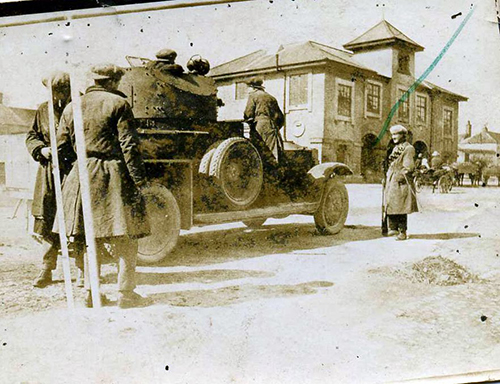
A rare civil war photo...
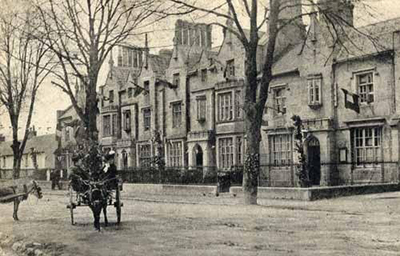
The above is a picture of the army barracks in Abbeyleix from 1837.
My father probably started working in Bessborough in 1923 as the treaty was ratified in 1922 and the Irish Free State was formed. The restoration work lasted till 1935.
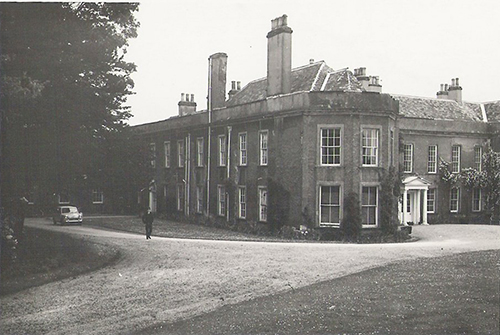

My Siblings and I

I was the second of 6 siblings who lived beyond their early years: Ted, myself, Helen, Henry, Muriel, Margaret. Only 5 of us survived into adulthood since little Margaret was not yet in her teens when she died. Most of us lived normal lives but Henry had a learning disability which meant that he found it harder than most to function in the real world. The picture shown here is of my sister, Helen, who later emigrated to New Zealand, at the age of c. 17, in Abbeyleix. She always dreamed of travelling the world and she succeeded.
INCIDENTAL FINDINGS
Princess May of Teck
Muriel has a copy of my father's reminiscences of Abbetleix House which he wrote down for Miss Aileen FitzHerbert before my mother died. He spoke of his father showing him a bookcase in Lady de Vesci's boudoir and telling him he had made a replica for Princess May of Teck. She had visited the de Vesci's by train and my grandfather and Captain FitzHerbert had laid the red carpet and handed her down from the train. She admired the bookcase and said she would like it as a souvenir of her visit. My grandfather later sent the replica to Sandringham. From a recent television programme I deduced that the most likely year of her visit would be 1891 as my father wrote that soon after she returned to England her fiancé died and she later married his younger brother, the future King George V.
Grandparents' Wedding
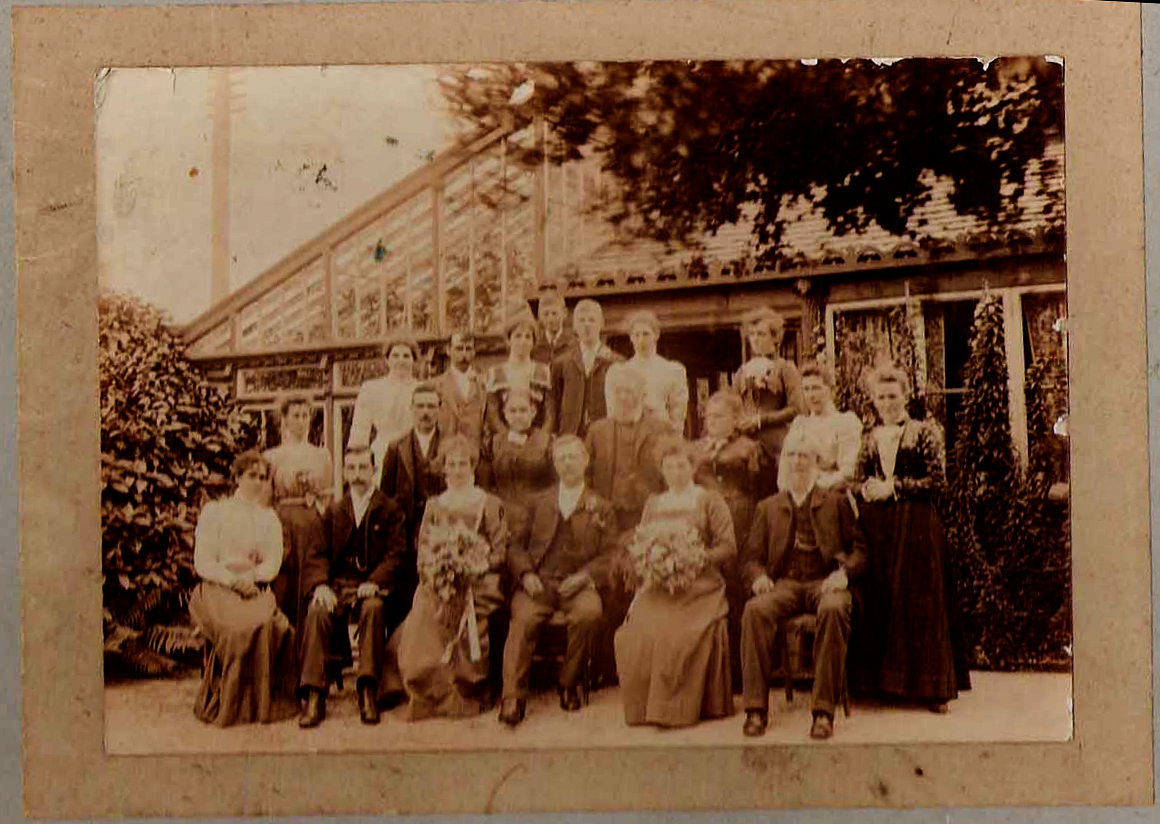
Among the papers which Richard has sent me is an old photograph. I pondered over it. Whose wedding was it? I contacted Aileen again and discovered that she has a wedding photograph of our Hartford grandparents, giving the date as February 1893 and the photographer as Lauder of Sackville Street, Dublin. The couple in her photograph, however didn't match those in mine.
Aileen then told me that the union of James Hartford and Martha Foster was an arranged marriage, one which made our grandmother utterly miserable. Our grandfather, a harsh, stern Victorian man, was twenty-five years her senior.
Muriel has identified the house in my photograph as the Shekleton's Nurseries in Blackrock, Dublin which she visited years ago. It was owned by my great-grandfather Shekleton, and passed to my grandfather's older brother.
The bride, therefore, may have been Mary Shekleton, my maternal grandmother. Mary was both my mother's mother and the sister of my father's mother. In other words, she was both my grandmother and my (great aunt?). Identifying the others in the photograph is difficult..moms' great-great-grandmother in the centre amongst the family of fosters?
Conclusion
The discoveries I have made so far have been amazing, some of them sad and horrific, others exciting and happy, but all of them illustrating the history of a significant era.
Sources of Information
I wish to thank everyone who has so enthusiastically helped me in my research:
Mr Laurence Spring of the Surrey History Centre.
My sisters, Muriel Hartford from Tonbridge and Helen Eggleton from New Zealand.
My cousin, Aileen Sanders, from Braunston, Northamptonshire. (Aileen met Mr Marcus Lewis who was researching the history of Norton Hall and the Thynne family).
Nephew and niece, Edward and Catherine Hartford, from Lincoln.
Nephew, Richard Hartford, and his son, Thomas, from Nettleham, Lincoln.
Nephew, Michael Hartford, and his wife, Margaret, from Nottingham.
Hazel Newman from Dublin, who has identified where my parents lived from 1919 to 1923.
The Revd. Dr Andrew Tatham from Surrey, who suggested Caterham and Kenley as two likely sites for the Camp in Surrey and who told me about Surrey History Society.
Michael McCormack, my husband, who has clarified the historical background of the period.
Other sources consulted
Cannock Library
Mormon Church, Exhibition Road, London, who, although they couldn't answer my questions, referred me to other sources.
Abbeyleix Church of Ireland Parish records.
Surrey History Centre, Woking, from whom I received invaluable information and further contact suggestions.
Births and Marriages Certificates among papers sent to me by Richard.
Ministry of Defence, Hayes, Middlesex.
Public Records Office, Kew.
Books
Hartford, M. 1997: My life in Ireland & England. Minerva Press, UK.
Faulks, S. 1994. Birdsong: Vintage, UK.
Keegan, J. 1999. History of World War 1. Pimlico.
Palmer, A. 1998. Victory 1918. Weidenfeld Nicolson.
Various short accounts in the reference library on World War 1 and on Sir Ernest Shackleton.
T.V. Programme on King George V and Queen Mary.
Enclosed:
Photocopies of:
a) My father's birth certificate
b) My mother's birth certificate
c) Their marriage certificate
d) Birth certificate of their first child
Copy of photograph of grandparents' wedding.
Family Tree from information in Abbeyleix parish records, and from details passed on by other members of the family, especially Aileen, Muriel and Helen.