The Life of Riley
One's early adult years are always full of hope and potential.
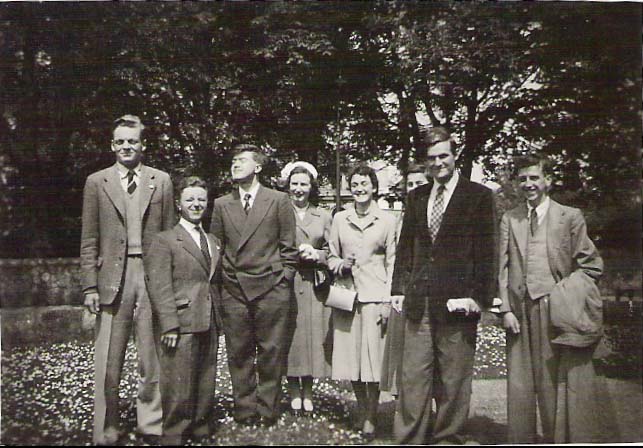
This first photo shows Trinity students from St Bartholemew's in St John's High Church in Sandymount. I am pictured here in a hat, with Adrienne beside me. I used to date John, the tall one, second from right, for a while but he was quite strange and never fully came to terms with life.
The shortest guy is Bill Fuge who, in 2017, aka in his late 80s, was spending half the year in Thailand and visiting Ireland once a year. He was still looking Adrienne (aconstance34@eircom.net) up at that time and she and Bill were also in contact with Hazel. Bill ended up lecturing in Lancaster University, championing gay rights and singing in the Cathedral choir there.
Bill's room-mate in Trinity was Nicholas, pictured on the far left, who unfortunately died soon after leaving college from a severe asthma attack. On Bill's other side is Arthur Little who lives in Wimbourne Minster in 2017.
Margaret Marin peeping over John's shoulder lives in Penrith in 2017. It was she who marched up the aisle hatless with me in protest against the ruling that women cover their heads!
Kenneth Armstrong whom Adrienne married is the very young looking one.
(Note from Anna..Harold was also part of this group but apparently doesn't appear in this photo).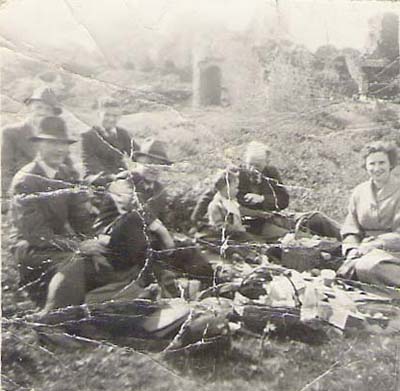
Dunamaase c. 1954 Uncles Charlie and Fred, brother Henry, uncle Eddie, cousin Christian, uncle Dick, me, and Diana on the way to see my father
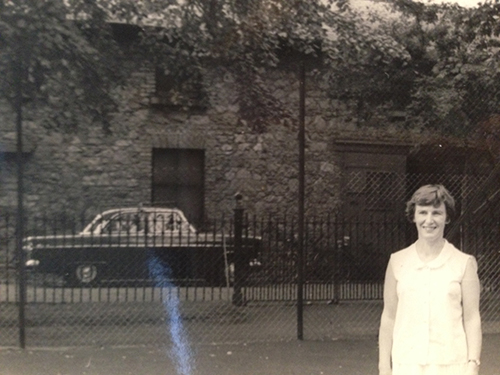
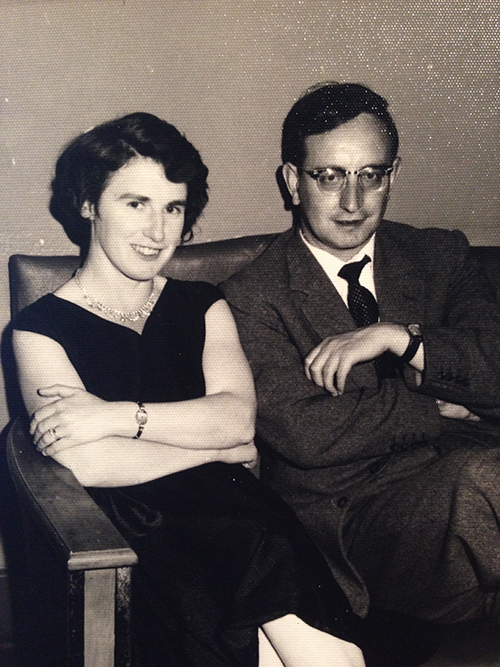
I (Anna) looked up Bill Fuge online and found this...which is interesting because of Mike Parson's association with this part of Lancaster University and Anna's attending fabrics conventions there...I wonder why we never went to visit him there...it wasn't so very far away...
She also found a recording recording of his thoughts about being gay in those early years.INDEPENDENT STUDIES: GONE BUT NOT FORGOTTEN
As trailed in subtext 31, the end of this academic year will see the closure of the Innovation and Enterprise Unit, formerly known as the School of Independent Studies (IS). The time thus seems ripe for a brief memoir. We hope very much that readers - not least, the large number of IS alumni who still live and work in Lancaster - will write in with their own memories, anecdotes and corrections.
The School had a complex history, which reflected both the struggles within the University over the relevance of different educational models and income opportunities, and the shifts in the dominant discourse in wider society. It was the brainchild of the colourful Wacek Koc, one of the first (l964) appointees of the first VC, Charles Carter. His radical idea, which he developed from similar initiatives in the USA, was to offer a degree which allowed students far more control over the structure and disciplinary spread of their degree, and far more freedom in their amount of independent research, and in their chosen topics and methods. After months of informal discussion, and heated debates at various meetings of Senate, the Independent Studies Part II was finally approved in March 1973, and started that October. Lancaster was thus the first UK University to set up such a School - though others such as North East London Polytechnic were soon to follow suit.
Frank Oldfield was its first Director, followed by Jane Groves (later Routh), Vernon Pratt and then John Wakeford. At the end of the 1990s the School was renamed the Innovation and Enterprise Unit, signalling a growing focus on the University's 'third mission'. Following Wakeford's retirement in 2002 Janet Clements held the fort for a year until the appointment of the present Director, Frank Dawes. BILL FUGE was the longest serving member of staff, working there from the beginning of the School almost to its end.
What exactly did IS do? The core of its activity was grounded in the five key principles of student responsibility for learning, deep learning, critical thinking, transferable skills, and freedom of learning experience. From 1973 it ran the Part II in Independent Studies, which allowed students to assemble their own undergraduate degree with modules chosen from any scheme across the University, with up to 2/3 being done as research dissertations supervised by relevant University academic staff. This allowed students to assemble a BA in Independent Studies on a particular topic, in which they approached that topic from various angles under specialist academic supervision. In 1990 the School started its own Part I, designed to help students develop a range of transferable skills related to independent research and reflection, mainly through group-based projects. At its peak in the mid-1990s the School offered not just the Part I and Part II in Independent Studies, but also an MA in Critical Social Psychology with the Psychology department and a professional postgraduate programme. It ran the £1m, 5-year Enterprise in Higher Education programme, where students in all departments engaged in community and commercial projects, and published a series of books on Innovation in Higher Education. It also contained the Centre for Science Studies and Science Policy (CSSSP) with its own MA in Society, Science and Nature and a PhD programme with ESRC quota studentships, and the ESRC-funded research centre the Centre for Study of Environmental Change (CSEC). After CSEC and CSSSP left to become separate departments, it started its own MA in Applied Research and Consultancy.
The School was always an object of controversy within the University. When it was first proposed there was strong opposition, particularly from Bill Potts of Biological Sciences and Alec Ross, the first Professor of Education. When its Part II scheme was approved in 1973, this was initially only for a five-year probationary period; students at this time were also required to register for a standard Part II scheme as well, on which they could fall back if their IS proposals did not work out. These fears were to prove groundless, but nevertheless, throughout the School's existence it encountered resistance and opposition from many throughout the University. Many academics, especially in the science faculties, saw the School as encouraging students to pursue self-indulgent and non-academic projects. Indeed, it was identified by John Patten, then Secretary of State for Education, as an example of the decline in standards in HE. The University management was uncomfortable with the scheme from the outset, and successive pro-vice-chancellors, including Nick Abercrombie in the mid-to-late 1990s, paid lip service to the concept while exposing IS to a level of sustained critical review not experienced by any other equivalent academic activity. They took the view that, although the skills learnt by IS students were valuable both educationally and to future employers, these should be being taught by every department, and didn't justify the continued existence of a separate IS. For others amongst the University management IS simply offended their tidy-mindedness: it didn't seem to fit anywhere, and they found it difficult to understand. With its conversion into the Innovation and Enterprise Unit it lost its status as a separate department, and therefore its place on Senate, and the quarrel over whether it should have its own UCAS code and student quota became even more entangled.
However, IS's academic achievements were impressive. Its undergraduate cohort tended to fall into two groups: one consisted of those who were struggling at Lancaster and went to the School as a last resort, but the other consisted of often mature students who were highly motivated, thrived on independent study, and did exceptionally well. Continuing prejudice against the School led to repeated academic reviews - the first as early as 1977 - but these produced reports which were uniformly supportive of its work, as were those of the School's external examiners. The School was commended in 1993 by the HEQC Quality Audit Report on Lancaster for the staff development opportunities it offered to academic staff, and the National Review of Science and Technology Studies carried out by the SRC-SSRC Joint Committee in 1989 classed CSSSP as a 'Centre of International Excellence'.
With a stream of talented graduates and many supporters, the University could not kill IS by frontal assault; instead it seems to have resorted to the death of a thousand cuts. Nevertheless, spin-offs of IS will outlive its demise, and can be found scattered around the campus. CSEC is now based in Sociology, and CSSSP became the Centre for Science Studies, which is now a 'virtual' centre involving staff from many departments. Similarly, even after this academic year some of its innovative teaching activities will continue, with the MA in Applied Research and Consultancy being taken over by LICA, and some of the Part II modules by Combined Sciences. Discussions are still ongoing about where the Part I in Independent Studies will reside.
What will be lost with the final demise of the School? Some might say its time has passed - that its original radical ideals have long since mutated into the ubiquitous buzzwords of our new managerial culture. But for others IS represented an essential part of the spirit of our University. Either way, Independent Studies is dead; long live independent studies. IS alumni will be marking the end of a fine Lancaster institution in an End of Department Party on 30 June (for more information, contact s.mahon [at] lancaster.ac.uk).
Do write to us with your memories. Here's one from an IS graduate from a while back.
'Here's a piece of trivia - through a quirk of fate, the novelist Dick Francis is indirectly responsible for me coming to Lancaster Uni. I was reading 'Straight' (1989), and came across the bit where the main character mentions that he left Lancaster University with a degree in Independent Studies, and immediately headed for the racetrack, instead of getting a normal job. I wondered what Independent Studies was, so I sent off for a prospectus, and here I am! I'd never have even considered coming to Lancaster if I hadn't read Straight. Ain't life weird?'