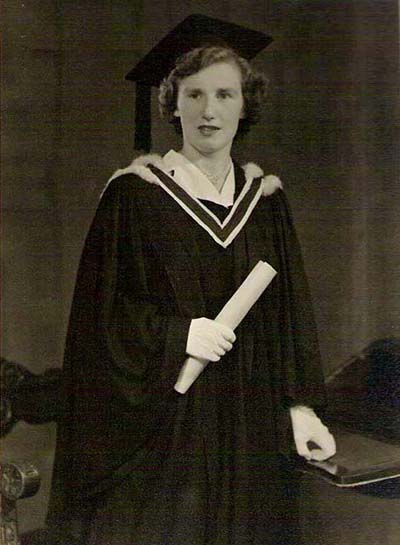
Training College
I did not want to go to training college. I wept. I pleaded. I prayed. I prayed that I would fail my Leaving Certificate examinations. There was one ray of hope for me. To teach in a primary school at that time one had to be able to sing. I couldn't sing a note. I had to attend an oral examination in Portlaoise. An inspector called Mr Coleman was the examiner. I couldn't sing. I should have failed and he told me so, adding that, in his opinion, I was far too young to face teaching at 19 years of age. I was then only 17.
There was a shortage of teachers in Protestant schools at that time so I expect exceptions would be made for us. Mr Coleman knew I wasn't happy about the career being planned for me. He said he would go away and weigh up all the pros and cons and make his decision later on. I went on hoping and praying. My parents said that if I didn't go to college I would have to go to England and join the WRAAF. This was meant to be a terrifying threat but I jumped at this thrilling alternative. The option was never repeated!
I gained high marks in my Pass papers in the Leaving Certificate and word came that I had passed the oral test. Training was free but part of the Church of Ireland Training College (CITC) course involved attending lectures in Trinity College, Dublin for the first two years of a Pass BA degree. We would have the option later on of completing the further two years part-time to have a degree conferred. In truth, the course was for those who failed to make it to university full-time and I hated that. It didn't help when some of the Trinity lecturers later said that I should have been studying for an Honours degree in university.
As it was, my parents would have to find the Trinity fees of £25 a year for the two years in Training College. They applied to the Government for a loan of the fees. Mr Moriarty was the inspector who called to the house to assess our degree of poverty. Only very needy students would receive the loan. There was no problem. When I began teaching, £10 a year was deducted from my salary for five years and I had signed a contract that I would not leave teaching during that time. It felt as if I was signing my life away. I met Mr Moriarty later when he came to our school on an inspection and I found him to be a jolly; friendly, compassionate man.
So, I set off for Dublin and my uncle met me at Kingsbridge Station and took me across to a hotel for tea and then hired a jarvey with his horse and trap to drive us to Kildare Place. It was 1945 and cars were still few and far between. The Principal of the College was Rev George Simms who also held the office of Junior Dean in Trinity. I had stayed with him in December 1943 when I was in Dublin for Uncle Dick's wedding so I guess this had all been planned well in advance. Rev Simms was a very saintly person and he ended up as Archbishop of Armagh, the highest office in the Anglican Church in Ireland.
The person who wielded real power over us was Miss Pearson, the Lady Registrar. I remember being told that she had been in love with my uncle Dick, so altogether I didn't stand a chance. My heart was never in the course I followed over the next two years but I enjoyed the friendships I forged there. In sharp contrast to our peers in Trinity, we had no more freedom than we had enjoyed in school. Our days were regulated and filled with what to do. Practical training was provided in Kildare Place and academic training given in Trinity. On Friday afternoons we attended Biblical Diploma lectures in Trinity and I was one of those who chose to sit for the Diploma exams. I liked anything academic and this was better than nothing!
Dr Pyle, a lecturer in English in Trinity, gave lectures to us in the Training College. One day he was reading an essay, sotto voce, and we were all drowsy and inattentive. The end of lesson bell rang. He went on reading in the same tone introducing the words 'the clock has struck' and it took several seconds for anyone to wake up and realise that those words were not part of the literature! As an end-of-course test we each had to learn two pieces to recite to him and then to answer questions. I already knew Milton's sonnet 'On His Blindness' and I had learned 1 Corinthians, Chapter 13 by heart in school. Both were favourite pieces of mine so I did nothing to prepare for the test. As I recited, I felt so lacking in motivation that I couldn't even do justice to my chosen recitations. Dr Pyle was far from amused and I received a taste of his sarcasm!
Six of us in my year were what were called Open Competition students. The other eight had come from St Mobhi's College, an Irish-speaking College all of whose students went on to training college. Those of us from ordinary secondary schools were lucky in that games and PE had featured large on the curriculum. We were glad that we could join Railway Union Hockey Club and the college paid our fees. As Protestants we couldn't attend the practices on Sunday but played in the matches on Saturdays. I remained a member of that hockey club till I was 28 and I played regularly for their fourth eleven and was a substitute on the third team. The club had six teams so I was just an average player. In summer we played tennis in Herbert Park, Ballsbridge and the college paid our fees there, too.
MAUREEN WRAY was a close friend of mine and together we found ourselves in many a scrape. We were tennis partners and we both shared a love of Mathematics. We found various ways of relieving boredom and frustration. We began sneaking out on Sunday afternoons, having first thrown our racquets out of the window on to the pavement in Kildare Street, and then going to play tennis in Herbert Park.
A Miss Dermody, who was an Irish fencing champion, came to teach us basic steps in Irish dancing and the idea must have been that we would teach our pupils in turn.
One day Maureen and I met an African man and he took a fancy to Maureen and he asked if he could play tennis with us. Maureen brought along a boyfriend who was one of two male students in the class below us. Very few men went in for primary teaching in Protestant schools in Ireland. Anyway, the three of us had some riotous laughter at the poor man's expense. On our way to Bible study lectures one Friday we met him in Woolworths. Maureen had bought a bar of Cadburys chocolate and he came up to us and said, 'Give me of what you are eating'. She broke off a square of chocolate but accidentally dropped it on the floor. He picked it up and said, 'The laws of hygiene tell me I must not eat it but I want it so badly'. He ate it and we were in hysterics.
At meals in the College we took it in turn to sit at the various tables, headed by a member of staff. We didn't like our week on Miss Pearson's table and we had to speak in Irish to her. Maureen and I had plenty to report about our African friend and we kept the conversation flowing. Suddenly, Miss Pearson told us to be quiet as we were monopolising the conversation. The others were then told that they had to make two remarks each. Maureen and I felt we had earned our enforced silence! It was hard going for our friends but we had done our bit to help them out.
We had Art lessons once a week and the teacher, Miss Smith, had a weird combination of colours in her clothes - emerald, orange, vivid purple, yellow, and blue. If this was arty, we didn't think much of it. We had blackboards and easels for drawing and Maureen and I were as dim at drawing as we were bright at Maths. We would each wait for the other to begin so that we could copy one another. We once ended up with a postage stamp-sized drawing in the top corner of our board. Another day we were peeping around at one another's board when we tripped and both easels collapsed. We were in disgrace! I think we must have been the most aggravating pair that ever passed through that college but, again, we shouldn't have been there, in the first place!
The College doctor was a Dr Murphy whose consulting rooms were in Fitzwilliam Square, Dublin's pale echo of London's Harley Street. He came in once a week to lecture us on Hygiene. He was an eccentric character and seemed set on shocking those who were strait-laced. Maureen and I always caught his double meanings so he brought us up to the front desk and when he was speaking, a spray from his mouth would reach our faces. Someone reported him to our matron so she decided to sit in on the lectures. He was determined to send her packing so he said to her, 'Miss Hazzard, these two brats (Maureen and I) are doing this behind your back.' He stuck his tongue out at her and I'm not sure if she knew whether we had done that or not but she made her escape and never appeared during his lesson again. She didn't like us after that and made it clear to us.
One day Miss Pearson had given us our lessons for teaching practice. She was checking that we all knew what we were to do so she called out the subjects one by one. When she came to 'English with Standard 4' no one replied. She repeated the query and still there was silence. No one was claiming English with Standard 4. I sat there dreamily thinking, 'Poor devil who doesn't know she is to teach English to Standard 4!' She consulted her list and who do you think the culprit was? She summoned me to her room and told me she had made an appointment for me to go to Dr Murphy's consulting rooms that afternoon to have my hearing checked. He gave me a right embarrassing interview and ended up by using some choice strong language. Translated into drawing-room language, it meant I was to say to Miss Pearson that he, too, was deaf when there was something he didn't want to hear. On my return to College I couldn't speak coherently when I was trying to report what he had said. I kept recalling his vivid language. We were the equivalent of first-year university students at that stage and less than two years from being respected teachers in Church schools! I think this episode proved beyond doubt how thoroughly unmotivated I was about teaching.
Early on in the first term a Government inspector came to test our singing. One by one we had to sing a few notes and he was a weird man. He said to each one of us that if we gave him a kiss he would pass us. I wasn't the least interested in passing and the thoughts of trading a kiss for a pass disgusted me. I failed my singing test and earned myself free time every week while the others were at singing practice.
I fell foul of our PE teacher, too. He arrived on Tuesday evenings to do Physical exercises with us. He seemed old to us and we heard that he was a PE instructor to priests in training. I was the leader of the group and we were practising to put on a display for the inspectors and College staff. It was Hallowe'en and he had brought bars of chocolate in. He called us up one by one and demanded a kiss in return for some chocolate. I told him to keep his chocolate and I had a bit of a rough time from him thereafter. He demoted me from being leader but had to reinstall me when the display began to fail. We had navy gym tunics for PE and those of us who played hockey had three rows of saffron braiding sewn on the hem. He ordered me to have the braiding removed by the following week. I had no intention of undoing all that sewing and redoing it in time for hockey so I went to Miss Pearson and told her my parents couldn't afford two tunics and all that sewing would leave me short of time for my studies. She ordered him to accept the braiding. I despised that man. I had come a long way from the days when I was a timid little mouse who wouldn't say 'Boo' to a goose!
A third man annoyed me in the final year. As I have said already, Trinity College was responsible for our academic achievements but a Government inspector came to make an oral assessment of our ability to speak Irish. This man was old and sat there with a rug around his knees. He was fiercely nationalistic and when he asked me where had I gone to school, he sat there rudely berating me for having the audacity to admit that I had attended a school with such a treasonable name as 'Rochelle'. I should be ashamed to call myself Irish. Then he said, 'You have failed'. The Professor was furious and argued that I was the last student anyone would fail. It was the only time, apparently, that such a disagreement arose between a Trinity lecturer and an Irish government official and I despised that horrible man and those who put him in a position of power. Government policy at the time was to lean over backwards to prove to the Protestant minority that they had nothing to fear from the majority. This man seemed to me to be just the sort of person in authority whom we might fear. Looking back now, I find it difficult to visualise the bigotry and divisions that existed between the two sections of the population at that time.
My fondest memory of CITC is of the evening services in the beautiful chapel across the Quadrangle. I can still feel the peace of sitting in the chapel with the evening sun shining through the stained glass window, and listening to Dr Simms reciting that beautiful prayer, 'When the evening shadows fall and the busy world is hushed'.
In my second year I was one of six chosen to learn to play the organ. Our tutor was George Harrison, a gifted organist. I won the gold medal for my year when another organist came to hear us play a prelude and fugue by Bach. I was so nervous but suddenly I felt inspired and although I am most unmusical I played as I had never played before. I pulled out all the stops in more senses than one! I was so proud of that medal. We took it in turns to play at College services for a week at a time.
On Sunday mornings we dressed in our academic gowns and donned our mortarboards to attend the 10am service in Trinity Chapel, a compulsory duty for all students at that time. We sat in the stalls to the left as we entered. Alongside our stalls was where the male students sat and opposite them were the Trinity females while opposite us were the lecturers and professors. As we entered the chapel, a senior student collected our name cards in his upturned mortarboard. It was virtually impossible to slip in someone else's card undetected. Many of us went on to St Ann's in Dawson Street for Morning Prayer at 11 o'clock. There we would see Dr Murphy taking up the collection with five other churchwardens. He stood head and shoulders above his companions.
We had more contact with the divinity students in Trinity than with any other group. Inevitably relationships developed. Maureen was very attractive and she had lots of admirers. I remember one evening when the divinity school joined us for a special service in our chapel, conducted by Archbishop Barton. After the service we suddenly thought it would be fun to have an impromptu ceilidh while these young men were on the spot. I was delegated to chase across the quadrangle to call back those who were leaving. I suffer from night blindness and I could just about make out the dim outline of a figure walking away so I shouted, 'Hey! Come back and join us for a ceilidh.' A deep booming voice that I recognised only too well called back, 'Patricia, I shall opt out of that if you don't mind. I'm sure you will find lots of younger men to join you.' It was the Archbishop, whose daughter was married to my uncle! Episodes such as that kept me sane during those tedious two years. All through my life I have found that as long as I can laugh and make fun of life I am all right.
I was also friendly with Pat Smyth and Muriel Exell. Muriel had been a year ahead of me in Rochelle and she had arrived a little late in College to fill the place left by a friend of Maureen's who decided on a different career. Muriel belonged to an evangelical group in Trinity called the EU (Evangelical Union). I sometimes went to meetings with her. There would be a good spread for supper and they were a jolly crowd. I was a lot less religious than I had been but I admired the zeal of these young people and I liked the cakes they served!
Miss Pearson took us for needlework lessons and we practised the kind of thing we might expect to teach in a national school. We kept a notebook with samples of hemmimg, backstitch, buttonhole stitch and so on. We learned to knit a sock and turn the heel. There was a certain way to hold the needles while knitting. I won a prize for my needlework. Would you believe it!
Miss Millington, a lady from the Sunday School Society, came in once a week to lecture us on how to teach religious knowledge. In a church school this would be the most important subject. Rev. Simms took a class in the mornings and he encouraged us to ask questions and discuss our faith and hold our beliefs up to the light. I was happy with this and enjoyed examining what was important and what wasn't. We could ask questions anonymously by dropping them on a slip of paper in a box and Maureen and I put the question: 'Is it wrong to play tennis on a Sunday afternoon?' Of course, everyone knew who had asked that question and I think Rev Simms knew, too. The answer was in our favour. Some in the class had disapproved of our playing games on a Sunday. Today this sort of restriction is incomprehensible.
Six weeks of each year were spent doing practice teaching in the Model School, attached to the College. The pupils knew we were students and ran riot whenever we were left unsupervised. They called Miss Pearson 'Fairy Feet' and kept a lookout for her return. Then they sat looking like little angels. City kids, particularly the boys, were quite unruly and the women teachers found it hard to control them. Most of the country schools would have only one or two teachers and pupils would range in age from 5 to 15. Some of us might have to teach in other schools and we were given bus tokens to pay our fares. One old penny was a common fare at that time and we had trams in some areas.
If we wanted to go visiting in the evenings we had to get permission and if our work wasn't up to standard we mightn't have permission. In any case we had to be in for roll call at 9 pm. As budding teachers we were expected to act like pillars of society! My uncle and aunt invited me out to supper regularly and usually asked me to take a friend along. Maureen and I went by bicycle once, cycling from Kildare Place to Churchtown, and we had no lights on our bikes, and this was against the law. When a policeman stopped us we had to plead with him not to issue us with a summons, as this would mean expulsion and no career. Times were so different in so many ways in those days.
I remember one Bank Holiday a group of us joined some divinity students and cycled to the Waterfall beyond Powerscourt in County Wicklow. It was a fair distance and we left it a bit late to set out for home. I grew panicky and breathless when we had to pedal with all our might to make up some time. One of the men cycled along beside me and pushed me on at speed. He and I became close friends later on and we stayed close till 1956. That evening in the summer of 1947 we were descending a steep hill in Milltown outside Dublin and at the bottom was a t-junction with a stone wall right in front of us. One of the girls couldn't slow down in time so she crashed into the wall. We used her fall and her injuries to explain why we were late for roll call!
During our final term we were busy looking for jobs and I had been offered one in County Wicklow but I wanted to stay in Dublin so my uncle arranged with the rector of St Catherine's in Donore Avenue to give me a post in the parish school. Two of us managed to secure city appointments. We would share accommodation over the years to come.
I was never sure if I would actually manage to stay the course. I guess I would have had to do something pretty drastic to have myself kicked out! Maureen and I almost managed it! Easter was approaching and we had one more term to put in. A covered walkway led from the main college to the gym and chapel and model school. It could be eerie there in the evenings. Maureen and I used to go to the gym and practise various exercises. One evening we arrived at the gym and switched on the lights. We heard a banging coming from a walk-in cupboard and a man's voice calling out 'Help!' We were petrified and we ran back and fetched Miss Pearson, repeating in terrified tones, 'Taibhse! Taibhse!' This means in Irish 'A Ghost!' We grabbed her and pulled her down the passage and pushed her in to the gym and left her to face the music alone. The caretaker had locked himself in the broom cupboard. Miss Pearson told everyone she met about the two students who left her to face the ghost alone! I think she secretly derived a lot of amusement from Maureen and me.
On another occasion we arrived at the gym and switched on the lights and stood still when we realised we weren't alone. A senior student and the old PE instructor were locked in a close encounter on the bench. We fled, scared and horrified.
The most traumatic incident was during the last week of our penultimate term. It was mid-afternoon one Sunday and we were bored stiff. We decided to visit the gym but on our way down we noticed that the door leading into offices next door was ajar. The temptation to enter and snoop around was too great. We assumed the place would be empty on a Sunday. We had a great time and arrived in what looked like the chief office. What secrets we discovered in the bundles of private papers! Suddenly, we heard footsteps approaching. We were petrified. We knew those footsteps were going to lead to the office we were in and there was no escape so we hid behind the door, intending to make a run for it once the person was safely inside. It didn't work. The man spotted us at once and ran for the telephone and started dialling 999. We grabbed the phone and screamed that we were training college girls who had discovered the open door. For the next half-hour that man made us sweat with fear. He marched us down by the scruff of our necks to a basement room and locked the door and made us write our names on a piece of paper. He then threatened to call the principal to come and fetch us. Eventually, he said that he would see if we had disturbed any papers and if anything went missing within a week we'd be held responsible. He escorted us back to the connecting door and sent us on our way.
We were so scared that we watched out for him to leave and about two hours later he emerged and we followed him up the street and he entered the Shelbourne Hotel on St Stephen's Green. We went through the swing doors and accosted him in the hotel lobby. We clung to him and begged him not to report us to the college. He was highly embarrassed by having us there in such a posh hotel so he gave us a promise that he would think about it. We spent the next week in agony and on the Monday we froze when we saw Rev Simms enter the dining room at lunch and speak to Miss Pearson. Then she pointed to where Maureen and I were sitting and he went out. Later on, she said to us, 'Do you know my friend, Mr Kelly of the Agricultural Credit Society next-door?' She was smiling as she asked this seemingly innocent question and she appeared to enjoy our discomfiture. We knew he had told Rev Simms and checked up that we really were students there. We had a lucky escape but we had to suffer several more remarks from Miss Pearson who seemed to be enjoying making us wriggle.
We both survived and received our certificates of education and succeeded in completing our probationary year of teaching. As I look back on those two years, I think of my daughter's four years at Aberdeen University and her post-graduate years in Leeds and Oxford Universities and, more than ever, the changes over my lifetime amaze me afresh.
In later years, at a training college reunion I met Mrs Finney again. Archbishop Simms had asked me to attend a big reunion in Rathmines at which he was to preside and when I turned up there he had eyes for no one else till he had greeted me warmly. He and I corresponded and recalled the Dublin days till he had his final stroke. He got on really well with my husband and loved to discuss the economics degree in Trinity that his son had taken as my Mike had too.