1st Teaching Post
My first teaching post was in St Catherine's Boys School in Donore Avenue, Dublin. The church nearby was St Victor's and the rector, our school manager, was Rev TJ Johnston, his curate being Rev Baynham.

The headmaster was Mr Power while the girls' school in the same building had Miss Spencer and Miss Halpin who, after marriage, became Mrs Aitken. I was in charge of the younger boys but took Mr Power's older lads for history while he took singing lessons with mine. Some of the senior boys weren't that much younger than I was at 19!
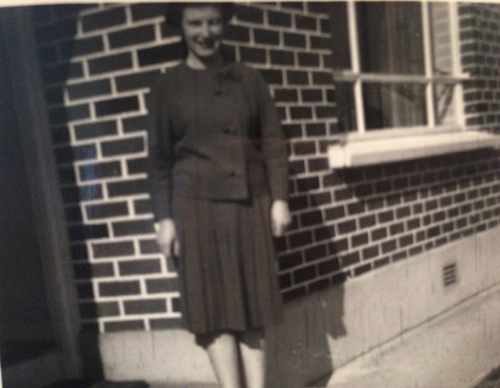
Mr Power soon began to treat me as the daughter he and his wife never had. Their only son, Douglas, studied engineering at TCD after leaving Mountjoy School and he is a few years younger. Mrs Power was the daughter of Scottish people and she told me about the time in 1917 when she was 11 how she went with her parents to Fordville where my grandfather was arranging for my father to go and work for Mr Dickie in the Kilkenny Woodworkers. In other words, our family's lives crossed, early on.
When Douglas graduated, his parents gave a wonderful 21st birthday party for him to which I was invited. We both still talk about that party!
I taught in that school for nine years and when Rev Johnston retired, he was succeeded by Norman Commiskey, a very different kind of person.

After Rev Baynham married and moved to a rectory in Co Wicklow, Noel Willoughby came as curate and he later became Bishop of Ossory and not many years ago he dedicated a plaque that Muriel erected in memory of our father in Abbeyleix Church.
It was also a Confirmation service and suddenly during the sermon I realised Noel was telling the children about the lady in the congregation whom he had known when she was a young teacher and he was a curate in Dublin. My cousin Rob was there and he touched my back to let me know he knew who it was! Noel and I had a good chat about the past after the service.
I learned to play the organ in college and my uncle got me a little Sunday job as organist in Newcastle and Rathcoole churches, ten miles from Dublin, so every Sunday I caught the 9 am bus from the quays to Rathcoole in time to play at the 10 am service and then the rector, Canon Shea, drove me on for the 12 noon service in Newcastle. My fee was 21 guineas a year plus my bus fares and my Sunday lunch. Two of his daughters, Marion and Doris Shea, lived at home in the rectory. Their mother had been a wealthy English lady but she was dead.
We remained friends with Marion and Doris till their deaths when Anna was a child. Theirs was often the first house that we would visit when our feet touched down in Dun Laoghaire Dublin.
Sometimes, I earned an extra guinea for standing in for organists, as in Abbeyleix to give Mrs Mitchell a break and in St Nahi's in Dundrum for the Sunday evening service. Uncle Dick is buried in St Nahi's. I was also sometimes called out of school by Norman Commiskey to play for a weekday funeral as the organist worked in Findlaters during the week and just played on Sundays. He was a friend of the guy whom I met in the RAF Association and who invited me to their annual ball!
I bought a bicycle on hire purchase in the early 1950s. It cost £10 and the interest came to £2.50, payable over a year. It didn't have any gears but I rode everywhere on it. During the summer a friend and I would meet most evenings at 7 pm and cycle out to Dun Laoghaire or Malahide or somewhere else and maybe walk the pier in Dun Laoghaire or along the beach in Malahide and set out for home again by 9 o'clock.
When Beryl and I started teaching in 1947 we stayed in a bed-sitter which was part of the Girls Friendly Society Oak House accommodation and afterwards moved in to Oak House till we grew tired of hostel-living and got a flat in Number 100 Upper Leeson Street. Then we had the chance to rent the upper half of a modern house in Whitehall Road, Terenure, and we invited Freda and Gaye, a younger teacher, to share it with us.
When I was saving for my trip to Germany in 1950, I moved into the YWCA in Ranelagh. Every morning through the Summer, Mar, a young evangelical Trinity student from the North, and I would go across to the tennis courts and have a brisk game before breakfast at 8 am. The whole ethos of the place was evangelical and I was glad of my organist's job on a Sunday to excuse myself from the Sunday morning Bible-reading sessions!

I remember the day two Presbyterian students from Magee College in Londonderry passed their BD exams in Trinity and invited Mar and me out to Howth by bicycle to celebrate. We walked all day over Howth Head and set out to cycle home at 7 pm and stopped in O'Connell Street and chained our bicycles to a statue and went into Cafolla for Knickerbocker Glories! They cycled back to Ranelagh with us in time for our evening roll call and as we cycled past Trinity they shouted at the tops of their voices. It was a wonderful day with two lads who were about to be ordained as Presbyterian ministers in the North of Ireland, a day with no strings attached, just one of sheer joy shared with us.
From the hostel I moved to a flat in Ranelagh with Pansy, a recently qualified teacher. What I most remember about that time was having to store our bicycles in the living-room. My final lodgings were in Gilford Drive, Sandymount, where I lived as one of the family with Capt and Mrs Tyrrell, active Methodists whose two sons had left home, Ivan as an officer with the Merchant Navy and Ken a vet in England. They introduced me to everyone as their adopted daughter and they were hoping Ivan and I would marry but we agreed that what we felt for one another was as brother and sister and it was indeed good to have an older brother looking after me.
In the early 1950s I volunteered to help at the Missions to Seamen on Eden Quay. On Sundays we were there to entertain sailors from visiting ships to tea and Tuesday evening was dance night when we danced with the sailors and ended the evening with a short service of worship at which I played the organ. We were strictly forbidden ever to accept invitations from the sailors but we could form friendships with the divinity school students who, in return for their volunteering, had free accommodation. Around that time, too, I became friendly with a group of students who were members of St Bartholomew's Church in Ballsbridge and St John's in Sandymount, which adhered to more high-church practices. Until my break with the Protestant church we spent all our spare time together, going to theatres and cinemas, dress dances and dinners, and for lovely drives on Sundays down through Co Wicklow.
So the years passed. In 1948 I had decided to sit for the second half of the Biblical Diploma exam, having sat for the earlier part while still in the training college. Each Friday over our two years there we attended lectures in Trinity with other students, mainly divinity. Then in 1951 I re-enrolled on the BA General Studies course as an external student and for the following two years I studied and presented myself for the various examinations and gained my BA in 1953. It wasn't what I had wanted but it was some part of being a student. Marion and Doris Shea were the only guests of mine at my conferring. Having a degree entitled me to an extra increment on my salary as a teacher.
Always restless and feeling my life hadn't gone as planned, I was forever applying for jobs abroad and with the shortage of teachers everywhere at the time I always succeeded in being offered the post. Then, when my mother was so upset at the thoughts of losing me I relented and withdrew. There was the post with the Army in the Middle East where I would be known as Major Patricia Hartford and enjoy officer status without the drawbacks. There was the offer of a post in Pietermaritzburg but I would have to be prepared to learn Afrikaans, and the offer of becoming an Inspector of Schools in Rhodesia where I would enjoy all the benefits of living as a white ex-pat. All sounded really glamorous and exciting jobs compared with my dull post, teaching tables and spelling, reading and writing and arithmetic, and religious knowledge to little boys.
Perhaps there is something in the doctrine of pre-destination that determines how our lives will develop. I am confident and grateful my life has taken the direction it did.