Post-Marriage Years
Our first home was 40 Orwell Gardens, Rathgar. We rented the house from a Miss Loane whose uncle was the RC Bishop of Cork. She had bought the house to store her antiques as she worked for an antique shop in Grafton Street. She visited us regularly and kept us amused with tales of scandal about well known people. We had been there for about a year when she announced that she had decided to become a nun with an order in Brighton and would be selling the house. We went house-hunting and decided to reserve a yet-to-be-built house on Barton Road East in Churchtown. A Mr Murphy was building four semi-detached modern houses as an extension to those already there and one large detached across the road for himself. While we waited for the building to be complete, we stayed with Miss White, a fellow-teacher of mine, in her house in Mountain View Road, Ranelagh. Our new house cost £1750!
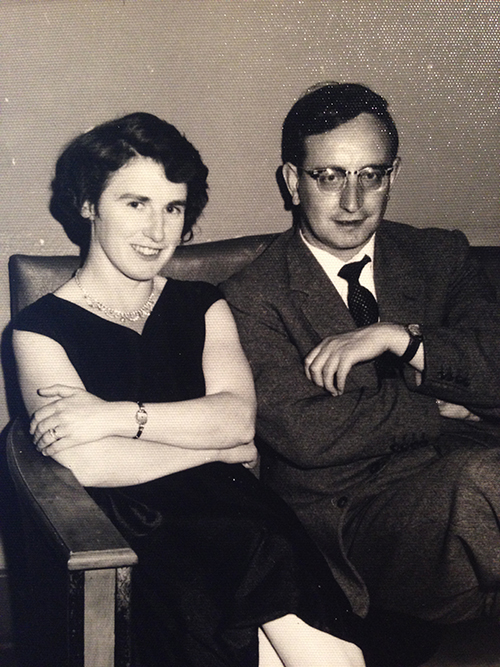
In many ways, our days in Barton Road were amongst our happiest - probably particularly for Mike. Shortly before his death in December 2014, he asked me to take him back home to Barton Road and I wished sorely to have been able to turn back the clock for him.
Helen and Jas joined us for our first Christmas and we travelled together by train to Abbeyleix to spend Christmas with my parents and my brother, Henry. Mike and I stayed in the de Vesci Arms Hotel in the town and walked out to Ballytarsna each day. My mother seemed very unwell, but I wondered was it because she was dreading saying goodbye to Helen and Jas as they would be sailing off to New Zealand in the New Year. My mother later developed bad varicose ulcers and I went home to see her and take her to the doctor. For a few moments our hearts stood still with shock as we misinterpreted the doctor's words: You will have to get off those legs. My mother started to shake violently and I stretched my arms out to her to comfort her and then understood that the doctor meant she would have to rest her leg.
Miss FitzHerbert asked me if I'd take my mother to Tramore for a week's holiday and I agreed. We stayed in a guest house at the end of the promenade, run by a Methodist lady, and there I would take breakfast up to my mother each morning and take her out to the garden for the afternoon to sit in the sun. It was perhaps the first real holiday she had enjoyed throughout her life. Her lot was not a happy one. I was entitled to free rail travel including boat and trains to Britain and the Continent. I ordered afternoon tea for us on the train and I remember my mother being amused at the movement of the train and the rattling of the teacups!
Early in 1962 I went home on a brief visit and my father caught me on my own and told me that my mother had been diagnosed with stomach cancer and the local surgeon said he wouldn't operate as it was incurable. I then asked my father to bring my mother up to Dublin and I would ask our doctor to see her. Mike was covered by private medical insurance at work and our doctor at that time lived in Rathfarnham. He came to see my mother on Barton Road and made an appointment for a surgeon in the Adelaide Hospital to see her. Mr McCollum said he would operate and it would give my mother an extension of life so she was admitted to a ward. She was happy when I contacted her former rector and his wife, Archdeacon and Mrs Nevill, who had retired and lived in a bungalow at the bottom of the hill leading up to Barton Road. I remember when I went up in the lift to the ward the porter joked with my mother saying he'd see her in a year's time. She must have been inwardly scared, but she was putting a brave face on it.
On the morning of her operation my Uncle Dick was being buried and Aunt Fanny and Uncle Willie and Rob from London had come over. While they and my father were at the funeral I was to be in the hospital when my mother woke up and I was to hide the news about Uncle Dick from her and if she asked about the family from London I was to say they'd come to see her. When I arrived on the ward, she asked me immediately if I knew that it was my uncle's funeral. Archdeacon Nevill had already been in and others in the ward had been talking so she knew all about it. As she recovered, she asked me one day if I'd make a jam sandwich and take it in so that she could share it on the ward for tea. Another day she asked me if I could find a siphon of soda water and I went in to an old pub near the hospital and they gave me a gift of one to take in to the hospital.
She did have a brief time when she enjoyed a life very different from previously. I took her to a dressmaker and had a new dress made for her as she had lost a lot of weight. She and my father came to us for Christmas 1962 and Ted invited her across to Lincoln and he gave her a good time. He took her to the highest pub in England, and she wrote to tell me about it.
Sadly, by the autumn of 1963 when I took her back to see Mr McCollum he told me the cancer had spread and she would need help before long. By this time Mike and I were in England but back and forth to our Barton Road house regularly. That Christmas I asked my parents to spend Christmas with us, but they declined. I offered to let them move to our house where they would have medical help at hand but again they declined. I went down to see them and knew my mother was ill. I arranged for a woman they knew to go up regularly and clean and shop for them and I paid her but my mother got worse and plans were afoot for her to spend her final time in Aut Even Hospital in Kilkenny and I wrote to the hospital begging them to look after her. Muriel, however, went home and looked after both of our parents. I was teaching in Westcliff-on-Sea and shortly before our half-term I received an urgent phone call from the rector, Rev Finney, asking me if I could get leave to go home as my mother was fading fast. The school and the Education Authority were very sympathetic and gave me paid leave. Mike was a student in Garnet College in Roehampton at this time.
My mother was still conscious and she said to me: 'Now all my children have come, except Helen'. Helen was in NZ and there was no way she could travel back to Ireland but after my mother went into a coma I took her hand and whispered: 'Helen has come.' It was a traumatic time for us, watching her suffer but she had begged me not to let anyone shorten her life by as much as a second and I kept my promise. I remember returning to the cold empty house after the funeral and Miss FitzHerbert said to me: 'I don't imagine you will ever want to return to this house again now that your mother has gone.'
For some time I had been giving my mother little gifts of money and telling her to treat herself to chocolates or ice-creams whenever she was in town. I got her to hide it all at the bottom of her bag and keep it as a secret between us. When we'd been to see Mr McCollum in 1963 she handed it all to me and asked me if I'd keep it in my savings book for her. I kept writing and asking her if she needed me to buy anything for her, maybe a new nightdress, and she said I'd know when she wanted it but to keep it for the moment. It was only when she lay in a coma towards the end that I knew what she meant. While the funeral arrangements were being made, I withdrew every penny of what I'd given her and handed it to my father.
His reaction made me really angry and made me feel such hatred for him and his nasty mind when he asked how was he to know that I had given him all of my mother's savings. I rounded on him and asked him if he knew where my mother had got that money and I told him I had given her every penny of it but I had never intended her to save it up towards her funeral. Two months before she died my mother had rounded on him and told him he had kept her children from her, that none of us wanted to be anywhere near him. I remember thinking: 'Oh, Mam, you didn't say that when you should have. Now is the wrong time.'After she'd died he tried to tell me he'd loved her and there was never anyone else, and all I could think inwardly was: 'You could have fooled me.'
I took my turn at having him to stay afterwards and he kept saying nasty things about and to Mike, although he was a guest in our home and we took him to lots of places. The furniture in the Ballytarsna house was to go to auction but he had an antique writing desk that he offered to Ted who said he didn't want it. I offered to buy it but he replied with his usual spite towards me that he'd rather chop it up for firewood than let me have it!
After his death I told Ted and he said that had he known I'd have liked it he'd have taken it and given it to me later without our father knowing. Ted was upset when he heard about it. My father then gave it to my cousin Rob and asked him to take charge of whatever savings he had to cover his funeral. This is all in the past now but it is something that I can't forget. Is it at all surprising that Anna introduced me once to a young man as: 'This is my Mum; she hates men and she hates Americans.' Anna and her friends have helped me realise that most men are not anything like my father was.
My mother once told me that when she was young she would have liked to learn to play the piano but when her mother asked her father he said, 'Teach her how to cook and sew and clean and be a good wife. That's all she needs to learn.'
Family ties were no less difficult for Mike. He was estranged from much of his family after the wedding and it was only years later that I came, in part, to know some of his siblings.
Further work on Arthur and Marie and connections to Dad's family.