School Years
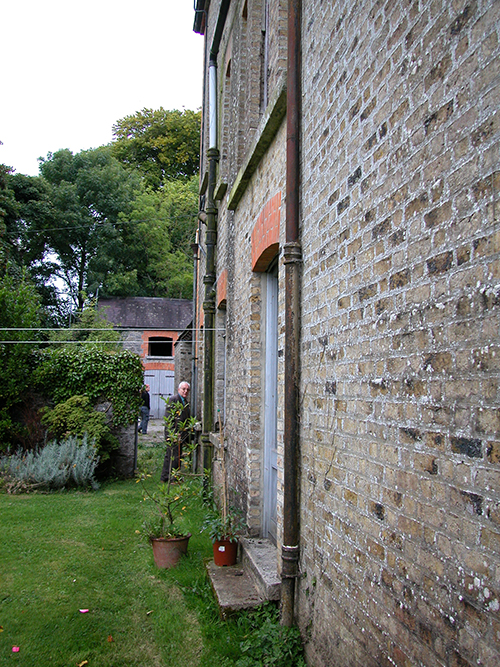
I started school when I was seven. It was unthinkable that anyone from my family - of Norman ancestry - should attend the local Catholic school. The nearest Protestant school was in Waterford. Our journey to school began with a two-mile bicycle ride to Fiddown station to catch a train to Waterford. Then followed a one-mile walk across the city to the Model School. In preparation, my father taught me to ride Ted’s little red bicycle. Ted was to have a new bicycle and the little red one would be mine. The three of us went out on the path in front of the Big House. My father lifted me up on to the saddle and let me practise turning the pedals. Suddenly he let go and off I went, but he hadn’t told me how to use the brakes, so I panicked, as I seemed to be gaining speed. I swerved on to the grass and crashed. Slightly cut and bruised, I didn’t want to repeat the exercise, but my father insisted and there we remained till I could ride a bicycle! I was ready to start school. I was looking forward to that and I was beginning to learn that in life you didn’t give up just because you didn’t succeed at first.
I could already read and write and do addition, subtraction, multiplication and division sums. I learned to read from 1 Samuel Chapter 3 in the Authorised version of the Bible. My father taught me the chapter by heart and then made me point to each word as I recited the verses. Then he taught me the letters in each word, letting me find all the 'a's, all the 'b's, and so on till I knew my alphabet. I can still see myself sitting in the big armchair with the Bible on my knee in front of the fire. It was an unorthodox method of learning to read, but it worked. I was hungry for learning. I thus found school very boring at that time. Having to learn Irish was new, however, and my parents couldn’t help at all. They had never learned Irish, but by the time I started school, the Government and the Church of Ireland had agreed that it would be taught in the Protestant schools and thus be compulsory nationally. It was written in the old Gaelic script.
The Model school in Waterford had two teachers. My brother was in the master’s class and I was with a Miss W. She scared the living daylights out of me. Thank God I would have to endure that school for only two months before we moved to a new area. Even now I can clearly relive the day I found myself standing with a fellow-pupil on top of a sloping desk during a singing lesson. The teacher was standing in front of the class with a thick wooden pointer in her hand. A tonic solfa chart hung over an easel. The teacher sharply tapped a tuning fork on the desk and gave the pitch for ‘doh’. Then up and down the scale the class chanted. Suddenly, the pointer darted about in a staccato, peremptory, menacing succession, varying the order of the notes. It was no rehearsal for ‘The Sound of Music’
My vocal chords were paralysed. I tried to produce the sounds but nothing issued forth except an inaudible choking gasp bordering on a nervous giggling. I was quivering in fear as the aspen leaves quiver in the breeze. The apparent giggling had landed me on the pinnacle of shame. It was an effort to prevent myself falling.
I knew that my parents had made it clear that we were never to be hit by a teacher and they took full responsibility for our behaviour. We wouldn’t dare misbehave because the cold treatment we’d receive at home was more terrifying than the risk of a crack from the cane. Other children were not so immune from blows. There were two brothers in my class, called ‘Wolf’. They came to school bare-footed, hungry and unwashed. They had no lunch in their satchels. When the time came to be tested on homework, they couldn’t recite their tables. They stood looking blank as the teacher confronted them, her face contorted in a paroxysm of rage. She started shaking them as if they were rag dolls, banging their heads repeatedly against the wall. I felt sick with fear. I wanted to cry out and tell her to stop before she killed those boys. I remained silent. I was too much of a coward and I was ashamed of my cowardice. The parents of those boys would do nothing, either. They seemed resigned to their fate. I often wonder if they survived the harshness of their childhood. They seemed born to be victims in a harsh, cruel world.
Seven years ago I met up with the son of the headmaster of the first school I taught in. We met at a dinner in Oxford and have kept in touch ever since. He sent me a photograph of ‘I W’, the teacher I have been writing about. She had been in college with his mother. In the photograph were two eighteen-year-old girls, laughing in the sunshine, as they posed for the camera. After more than 70 years I can still see that face so I recognised which she was. I stared and stared, trying to see the cruelty that struck such terror through my young heart ten years after the photograph was taken. Did she ever, I wondered, in the silence of the night experience a flash of conscience? Did she ever wonder what had become of those two boys?
Perhaps their punishments had fewer long-term effects than the psychological scars I suffered from the cold-shouldering I received at home on occasions. Opposite the rail terminus in Waterford was a wide bridge over the river, which we had to cross before walking along the quays and through the park to school. Sea-going ships sailed up the river and the bridge had to be raised to let them pass. Opportunities thus arose for two unwilling school kids to gain some extra time off school. If Ted and I caught sight of a ship approaching in the distance, we dawdled so that the bridge would be raised and we couldn’t cross. This would happen only on our way to school. We wouldn’t dare miss the 3 pm train home in the afternoon. We had permission to arrive at school half an hour late and leave half an hour early to fit in with train times. One day, to our horror, the bridge was up in the afternoon and we missed our train by a few seconds.
We had to wait till six o’clock for the next train. We hung around the station for three hours. There was no way of contacting our parents to let them know what had happened. On arriving home at 7.30 pm we expected a loving welcome, a hot meal, comforting arms around us. Alas! All we received was a stony silence, apart from one sharp angry command to go to bed at once and not open our mouths. There was no meal, not even a drink of water. Next morning there was no breakfast, no lunch in our satchels, no farewell, no homework to hand in. Shortly after arriving in class, I was called to Ted's classroom where the master asked me why my brother hadn't done his homework. Ted had primed me well on what I was to say, so he escaped further punishment.
I have never forgotten the misery of those two days. I cannot to this day understand how a parent could deny food and drink to a child, especially as both my parents would have been well aware of the possibility that the bridge was up. Neither of them asked for an explanation and when Ted tried to explain, he was told to shut up and go straight to bed. No wonder we all grew into nervous individuals, lacking confidence and always fearful and unable to relax. Perhaps our punishment was rough justice in that many a time we had escaped detection when we deliberately dawdled so that the bridge would be raised in the morning. Still, this could never justify the type of suffering we were subjected to.
It is strange what each one remembers from a particular period in one’s life. Long after my parents had died I asked Ted why he turned against religion and he told me a story our father had told him. My Aunt Frances told me once that my mother had lost ten babies before Ted was born. Two at least had lived for some weeks or months. The last one had died in early infancy, and when my parents contacted the rector he berated them for not having the infant baptised before he died. He accused them of sending that poor child to hell for eternity and he refused a Christian burial for the child. My father made a little coffin and carried it on the handlebars of his bicycle to a plot of unconsecrated ground where he buried the child. The story horrified me when I heard it. A few years ago I was speaking to the wife of a rector in that area. I asked her where that burial ground might be and she told me that it would have been a plot outside the church graveyard, reserved for people who had committed suicide or who had not been baptised, people outside the church for one reason or another. As my cousin Aileen said to me recently, those were ‘golden years tinged with rust’
Some of my memories from those days are of people long dead. We spent Christmas of 1930 in my father’s old home. My Uncle Dick, a young curate from Dublin at that time, was present, playing a leading role in organising everything. I didn’t know at the time but my grandfather was dying. All I saw of him was when the bedroom window was opened and this angry voice called down to Ted and me telling us to keep quiet. We were running about in the orchard. Children at that time were supposed to be seen but not heard. No explanation was ever offered but we were expected to obey blindly whenever given an order. We each had received a Christmas stocking from Santa and one of the contents was a ‘blow-out’. We were having fun blowing as hard as we could and producing a loud noise. We were crossly ordered to stop that at once! I was puzzled over why they gave us the toys only to tell us we couldn’t play with them. It didn’t sound logical but grown-ups were far from logical at times.
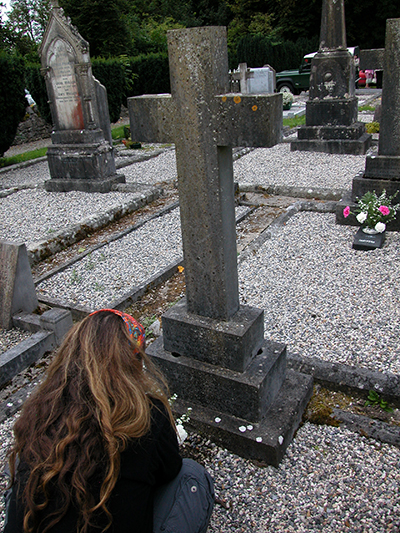
(Anna pictured in front of the grave of my mother, father and Margaret with my grandparents' grave, Aunty Gladys and Uncle Henry (with flowers in front of it), behind).
Another visit I recall was to my maternal grandfather who was the land steward on an estate in Ferns. We travelled there in a hired car and we drove up a long drive to the house and there sat an old white-bearded patriarchal man, under a chestnut tree. In the car on our way home my mother kept saying she saw the banshee in the dark outside. We children were scared and we kept ducking down so that the banshee wouldn’t see us. This fairy woman was supposed to appear, combing her long hair and wailing, when someone was about to die. I expect my mother was aware that her father was dying. She was an extremely superstitious woman.
My father’s mother came to visit us in 1935 and she suffered a stroke while staying with us. She and my mother were very similar. My mother almost seemed to be modelling herself on her mother-in-law who was also her aunt since my parents were first cousins through their mothers. Helen and I had taken Granny for a walk and suddenly she seemed to be running away in the wind and we were trying to hold her back. Next thing I remember is being taken in to the bedroom where she lay as if asleep and we were told to say ‘Goodbye’ to her. “Goodbye, Granny,” we chanted obediently.
My father was kneeling by the bed, his head bent towards his mother, weeping. In my childish mind it was distressful to observe my father crying. I guess Granny had just then died. I don’t remember what happened after that but I recall being in my father’s home once again. Everyone had gone out, possibly to the funeral, except Uncle Henry, who stayed to look after us children. He was making cocoa and he offered me a cup but my parents had warned me not to accept anything from him, so I pretended I wasn’t hungry. “No force, black pig,” he said, “I know your parents told you not to accept anything from me.”
There was an old ‘His Master’s Voice’ gramophone on the kitchen table and my uncle put on a record of hymns for us. I can still hear that far-distant tune to the words, “Will the angels play up yonder? Will the angels play their harps for me?”
The gramophone began to wind down and the notes to wail and drawl before my uncle wound it up again. He had TB and he died not too long after that. Looking back more than 70 years later, I find myself wondering if he knew he was dying and if those hymns were a comfort to him. “Shall we gather at the river?” was another part of that record.
I recall my Uncle Eddie arriving from London at that time with my Aunt Mary and my cousins, Maureen and Elizabeth. They stayed for a week in the Grand Hotel in Tramore, one of Ireland’s main seaside resorts. Ted and I had monthly season tickets on the train to Waterford and a branch line train continued to Tramore, a line long since closed. Our father often took us to Tramore at the weekend. My Aunt Frances also came from London that summer with my Uncle Willie and my cousin Robin. My uncle stayed with his family in Ardamine in Co. Wexford. Aunt Frances and Robin and my mother and Ted, Helen, Muriel and baby Henry stayed in the big canvas tent from Bessborough House. They pitched the tent on a hill behind the town of Tramore and each day they all went to the beach.
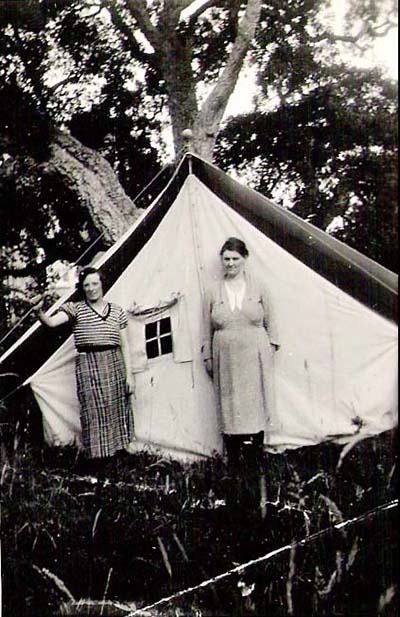
Taken in 1935 on a hillside at Tramore with Aunty Fanny and my mother.
My father had to be at work during the week, so I opted to return to Piltown with him from the Monday to the Friday. On the Friday evening we set off on his bicycle for Fiddown Station and on the way we had a toss. I was quite badly cut and bruised but my father warned me not to tell my mother I had been on the bike. No matter how closely my mother questioned me, I wouldn’t tell her how I came to have those cuts. Years later, before my father turned against me, he would comment on my loyalty and trustworthiness and steadfastness. It was our secret and ours alone.
Whenever I hear a small aeroplane droning above, I am back in Tramore, lying on my back in the hot sun on the beach, listening to my father and Uncle Eddie in conversation. They were close as brothers, both having shared memories of fighting in the Great War. As they chatted, a little aeroplane droned overhead. Again, that was a happy time for me.
My mother’s sister visited us one Sunday with two other ladies from Kilkenny and in the afternoon we went for a walk through the demesne. As usual, Ted was dragging me away to run about and play. My aunt had brought me a pair of new shoes. They were made of fine leather in two tones of green and they had a strap and a button, really partyish. I wore them at once and suddenly I wanted to run faster than my fastest. Possibly the idea was Ted’s and I was only too happy to fall in with his plans. He loved to tease his young sisters and many’s the scrape he got us into! That Sunday I was running on the gravel and the inevitable happened. My eye was spouting blood and I was screaming blue murder in shock. Everyone returned to the house. One of the ladies was, like my aunt, a nurse, and she asked my mother for some disinfectant to bathe the cut eye. My mother produced some Jeyes fluid that she used to scrub the floors with. To this day the smell of Jeyes fluid makes me feel sick. I think I should have had stitches on my eye but doctors cost money and my parents didn’t have any money to spare.
Christmas was always a special time for us children. There was the parish Christmas party to look forward to. We would play lots of party games like ring-a-ring-a roses and then we would sit down to have a tea party. Santa would come in and we would go up, one by one, to the big Christmas tree and tell him who we were. He would choose a present from the tree and give it to us. When I was five, I set off with Ted for the party but, as we crossed the cobbled yard, I tripped over an old rusty, galvanised iron bathtub and cut my left knee on the jagged edges. Blood streamed all down my leg and my lovely, frilly white party dress was blood-speckled. My mother rushed out when she heard my screams and I wasn’t allowed to go to the party. Ted said he would tell Santa what had happened and ask him to send my present to me. This he did.
Although we didn’t have a bathroom at home, every Saturday night was bath night. The tub was placed on the floor in front of a banked up fire and a clothes horse with towels on it was placed behind the bath to keep out the draughts. One after the other we were lifted into the tub and washed with Lifebuoy soap. The water had been heated in big saucepans. Our hair was washed at the same time and clean clothes laid out in readiness for Sunday.
The church played a significant part in our lives. There had to be a real reason for not attending Morning Prayer on Sundays. The Bible and the Book of Common Prayer were the major books found in the house. I remember, too, 'Uncle Arthur’s Bedtime Stories'. We had a red leather bound copy that my father had bought from a doorstep salesman. My father would read a story from it at bedtime. Each story had a moral. The one that has stuck in my memory is about a little girl who wouldn’t eat her cabbage. Her plate was left in front of her through meal after meal till she finally gave in. As soon as she lifted her fork to tackle the stale cabbage, her father took the plate away and produced all the party food he had kept aside for her! In my childish innocence and sensitivity I pondered long and hard on the moral. I really was sorry for that little girl who didn’t like cabbage for there were lots of things I didn’t like and didn’t want to eat. Fortunately, my mother didn’t force me to eat anything that made me feel ill. There were plenty of takers for any scrap of food left on a plate! Apart from the human dustbins, we had hens and ducks and a dog to be fed. The dog’s name was Scoot and I was terrified whenever he came near me. He seemed so huge to me. The cock in the yard was quite fierce and one day he started attacking baby Muriel in the pram. My mother, on hearing our cries, came out with a broom and beat him off. Ted used to tease the cock and that made him vicious.
I grew up scared of all living creatures from earwigs to humans! I remember a fox watching us once, as my father and Ted and I were about to go to sleep in the tent that we had pitched under the cork tree. A few years ago I was visiting my old school friend in Dublin and her cousin brought a friend to coffee. He was Jack Challinor who was Ted’s age and whose father was a commercial traveller for Denny’s, bacon and sausage manufacturers in Waterford, at the time we lived in Piltown. Jack remembered the fox and told me he had slept in the tent that night with us! His sister Phoebe was my age and we often played together. My father would sometimes walk down to have a chat with the Dad, Bertie, after tea. Catching up on the past like this is exciting.
I have so many lovely memories of those days and of Bessborough House and its surroundings. When the time came for the estate to be sold, my father was acting as caretaker. One of the potential buyers who came to view the house was the famous tenor, Count John McCormack. When they reached the dining room he exclaimed, “You couldn’t swing a cat in this room. It would be of no use to me when all my Italian guests come visiting.”
To me the house was a mansion, and the dining table seemed enormous. I remember thinking that the person sitting at the head of the table would be miles from whoever was at the other end. The bathroom, especially, fascinated me with its big white bath and running water. I used to dream of living in such a house.
It was sold to an order of priests, the Oblate Fathers, and opened as a seminary to train young men for the priesthood. As we moved away, I found myself crying and looking back at all the familiar places. There would be no more games of cricket in the yard where Ted was batsman, my father the bowler and I was fielder. The wickets and the bats and ball may have belonged to the Big House or they may have been a legacy of my father’s from his father, who had been secretary of the Abbeyleix estate cricket team. The old order was changing, giving place to a new one.
The header image shows Anna on the steps of the terrace of Bessborough House where the photo of Pat as a baby with Ted was taken some 40 years earlier.